
The links digest is back, baby!
I got so busy writing The Techno-Humanist Manifesto this year that after May I stopped doing the links digest and my monthly reading updates. I’m bringing them back now (although we’ll see what frequency I can keep up). This one covers the last two or three weeks. But first…
A year-end call to support our work
I write this newsletter as part of my job running the Roots of Progress Institute (RPI). RPI is a nonprofit, supported by your subscriptions and donations. If you enjoy my writing, or appreciate programs like our conference, writer’s fellowship, and high school program, consider making a donation:
- If you can give $100, subscribe to our paid Substack
- If you can give $500, make it a founder subscription
- If you can give $1000 or more, support us on Patreon, or see here for PayPal and other methods, including DAF and crypto
To those who already donate, thank you for making this possible! We now return you to your regularly scheduled links digest…
Much of this content originated on social media. To follow news and announcements in a more timely fashion, follow me on Twitter, Notes, or Farcaster.
Contents
- Progress in Medicine, a career exploration summer program for high schoolers
- Progress Conference 2025
- My writing
- From RPI fellows
- Jobs
- Grants & fellowships
- Events
- Miscellaneous opportunities
- Queries
- Announcements
For paid subscribers:
- What is worthy and valuable?
- Claude’s soul
- Self-driving cars are a public health imperative
- Slop from the 1700s
- The genius of Jeff Dean
- Everything has to be invented
- AI
- Manufacturing
- Science
- Health
- Politics
- Other links and short notes
Progress in Medicine, a career exploration summer program for high schoolers
We recently announced a new summer program for high school students: “Discover careers in medicine, biology, and related fields while developing practical tools and strategies for building a meaningful life and career—learning how to find mentors, identify your values, and build a career you love that drives the world forward.”
I’ve previewed the content for this course and I’m jealous of these kids—I wish I had had something like this. We’re going to undo the doomerism that teens pick up in school and inspire them with an ambitious vision of the future.
Applications open now. Please share with any high schoolers or parents.
Progress Conference 2025
- Our writeup: Reflections on Progress Conference 2025
- Big Think released a special issue after the conference, “The Engine of Progress,” featuring articles from Boom CEO Blake Scholl, futurist Peter Leyden, and six RPI fellows
- We’ve also started to release video of the talks, including:
- Tyler Cowen interviewing Sam Altman and Blake Scholl
- AI Protopia: Ideas for how AI can improve the world (track)
- New cities, housing policy, and lessons from the YIMBY movement (track)
More to come!
My writing
- “Progress” and “abundance”: “Abundance” tends to be more wonkish, oriented towards DC and policy. “Progress” is interested in regulatory reform and efficiency, but also in ambitious future technologies, and it’s more focused on ideas and culture. But the movements overlap 80–90%
- In defense of slop: When the cost of creation falls, the volume of production greatly expands, but the average quality necessarily falls. This overall process, however, will usher in a golden age of creativity and experimentation
From RPI fellows
- Ruxandra Teslo (RPI fellow 2024) and Jack Scannell have written “a manifesto on reviving pharma productivity … Public debates focus on improving science or loosening approval. We argue there’s real leverage in optimizing the middle part of the drug discovery funnel: Clinical Trials.” (@RuxandraTeslo) Article: To Get More Effective Drugs, We Need More Human Trials. Elsewhere, Ruxandra comments on the need for health policy to focus more on the supply side, saying: “The reason why I felt empowered to propose things related to supply-side is because of the ideological influence of the Progress Studies movement (Roots of Progress, Jason Crawford)” (@RuxandraTeslo)
- Dean Ball (RPI fellow 2024) interviewed by Rob Wiblin on the 80,000 Hours Podcast. Rob says of Dean that “unlike many new AI commentators he’s a true intellectual and a blogger at heart — not a shallow ideologue or corporate mouthpiece. So he doesn’t wave away concerns and predict a smooth simple ride.” (@robertwiblin) Podcast on Apple, YouTube, Spotify
- Andrew Miller writes for the WSJ about the inevitable growing pains of adopting self-driving cars: Remember When the Information Superhighway Was a Metaphor? (via @AndrewMillerYYZ)
Jobs
- Astera Neuro (just announced, see below!) is looking for a COO: “This is an all-hands-on-deck effort as we build a new paradigm for systems neuroscience” (@doristsao)
- Astera Institute is also hiring an Open Science Data Steward “to help our researchers manage, share, and facilitate new solutions for their open data” (@PracheeAC)
- Monumental Labs is hiring two Business Development VPs: “One will focus on large-scale building projects and city developments. Another will focus on developing new markets for stone sculpture, including public sculpture, landscape etc.” (@mspringut)
- Jason Kelly at Ginkgo Bioworks is “personally hiring for scientists that are automation freaks. Not that you run a high throughput screening platform but rather that you believe we should automate all lab work” (@jrkelly)
- Lulu Cheng Meservey is hiring a “puckish troublemaker” for special projects. “This is a real job with excellent pay, benefits, and budget. Your responsibilities will be to conceive of interesting ideas and make them happen in the real world, often sub rosa” (@lulumeservey)
Grants & fellowships
- Edison Grants from Future House to run their AI-for-science tools: “Today, we’re launching our first round of Edison Grants. These fast grants will provide 20,000 credits (100 Kosmos runs) and significant engineering support to researchers looking to use Kosmos and our other agents in their research.” (@SGBodriques)
- Foresight Institute’s AI Nodes for Science & Safety: “If you’re working on AI for science or safety, apply for funding, office space in Berlin & Bay Area, or compute by Dec 31!” (@allisondman via @foresightinst)
Events
- I’ll be speaking at The Festival of Progressive Abundance, LA, Jan 30–Feb 1 (@YIMBYDems)
- The Economics of Ideas, Science, and Innovation Online short course for PhD students, hosted by IFP, is back for the third time (@mattsclancy). Online, Feb 3–April 30
Miscellaneous opportunities
- a16z Build: “A dinner series and community for founders, technologists, and operators figuring out what they want to build next — and who they want to build it with. … It’s not an accelerator, or even a structured program. … Instead, we focus on one thing: creating small, repeatable environments where people with ambition, ability, and similar timing spend enough time together that trust compounds, decisions get easier.” (@david__booth)
- Vast’s Call for Research Proposals: “Vast is opening access to microgravity research aboard Haven-1 Lab, the world’s first crewed commercial space-based research and manufacturing facility” (@vast, h/t @juanbenet)
- A long-running project with HBO to make a series about the early days of Elon Musk and SpaceX has died. The series was based on Ashlee Vance’s biography, and he’s still interested in doing something with this: “If there are serious offers out there to make something amazing, my mind and inbox are open” (@ashleevance)
- Manjari Narayan (@NeuroStats) is looking for a co author to collaborate on one or more explainers about surrogate endpoints and other proxies in health and bio—including why we waste time and money on those that don’t work and how we can do better. She is the domain expert, all you have to bring is the ability to make technical topics readable and accessible to a non-specialist audience. Reply or DM me and I’ll connect you
Queries
- “It’s ‘well-known’ that science is upstream of abundance… I’ve found it surprisingly difficult to find strong general discussion of this link between science and our ability to act. … The best discussions I know are probably Solow-Romer from the economics literature, and Deutsch (grounded in physics, but broader). What else is worth reading?” (@michael_nielsen)
Announcements
- NSF launches a Tech Labs Initiative “to launch and scale a new generation of transformative independent research organizations to advance breakthrough science.” Caleb Watney, writing in the WSJ, calls it “one of the most ambitious experiments in federal science funding in 75 years. … the goal is to invest ~$1 billion to seed new institutions of science and technology for the 21st century.” (@calebwatney) Seems like big news!
- Astera Neuro launches, a neuroscience research program led by Doris Tsao. “We’re seeking to understand how the brain constructs conscious experience and what those principles could teach us about building intelligence. Jed McCaleb and I are all-in on this effort.” (@seemaychou)
- Ricursive Intelligence launches, “a frontier AI lab creating a recursive self-improving loop between AI and the hardware that fuels it. Today, chip design takes 2-3 years and requires thousands of human experts. We will reduce that to weeks.” (@annadgoldie) Coverage in the WSJ: This AI Startup Wants to Remake the $800 Billion Chip Industry
- Boom Supersonic launches Superpower: “a 42MW natural gas turbine optimized for AI datacenters, built on our supersonic technology. Superpower launches with a 1.21GW order from Crusoe.” (@bscholl) Aeroderivative generator turbines are not new, but Boom’s has much better performance on hot days
- Cuby launches “a factory-in-a-box” for home construction: “a mobile, rapidly deployable manufacturing platform that can land almost anywhere and start producing home components locally. … Components are manufactured just-in-time, packaged, palletized, and sent last-mile for staged assembly. … Full vertical integration from digital design → factory → site.” (@AGampel1) I’m still unclear whether this is going to be the thing that finally works in this space, but Brian Potter is a fan, which is a strong signal!
- OpenAI announces FrontierScience, a new eval that “measures PhD-level scientific reasoning across physics, chemistry, and biology” (@OpenAI)
- Antares raises a $96M Series B “to build and deploy our microreactors … paving the way for our first reactor demonstration in 2026. Two years in: 60 people, three states, a 145,000-sq-ft facility, and contracts across DoW, NASA, and others” (@AntaresNuclear)
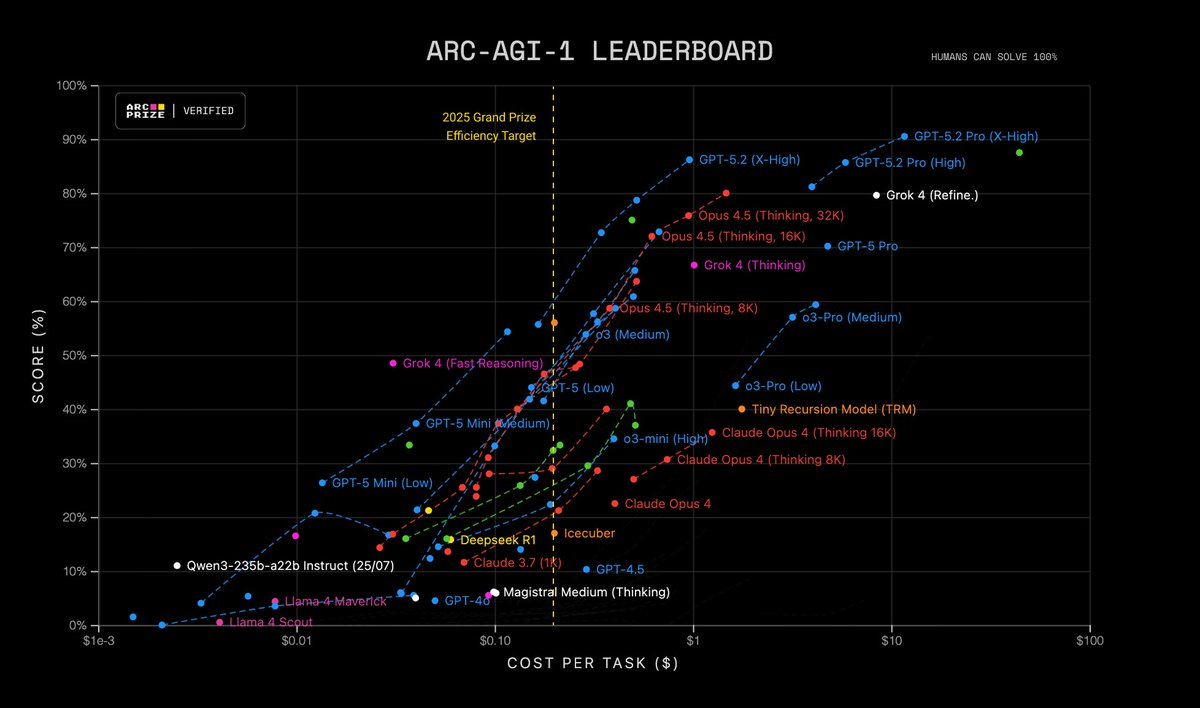
- GPT-5.2 Pro (X-High) scores 90.5% on the ARC-AGI-1 eval, at $11.64/task. “A year ago, we verified a preview of an unreleased version of OpenAI o3 (High) that scored 88% on ARC-AGI-1 at est. $4.5k/task … This represents a ~390X efficiency improvement in one year” (@arcprize)
To read the rest of this digest, subscribe on Substack.