
.jpg)
In 1834, Egypt had 400,000 cotton spindles producing thousands of tons of machine-spun yarn per year. Not only did it supply far more than enough to satisfy its domestic market but plenty left over to export to Europe. Its spindle count per capita was the highest outside western Europe and the United States, potentially ranking fifth in the world. Some thirty cotton mills, along with other factories together employed tens of thousands of workers and much the industrial machinery utilized in these factories was fabricated locally by Egyptian craftsmen. This is not a country that failed to try. Egypt understood, earlier than most outside the West, the importance of industrialization. This is the story of a country that tried remarkably hard but still failed.
Muhammad Ali’s Egypt
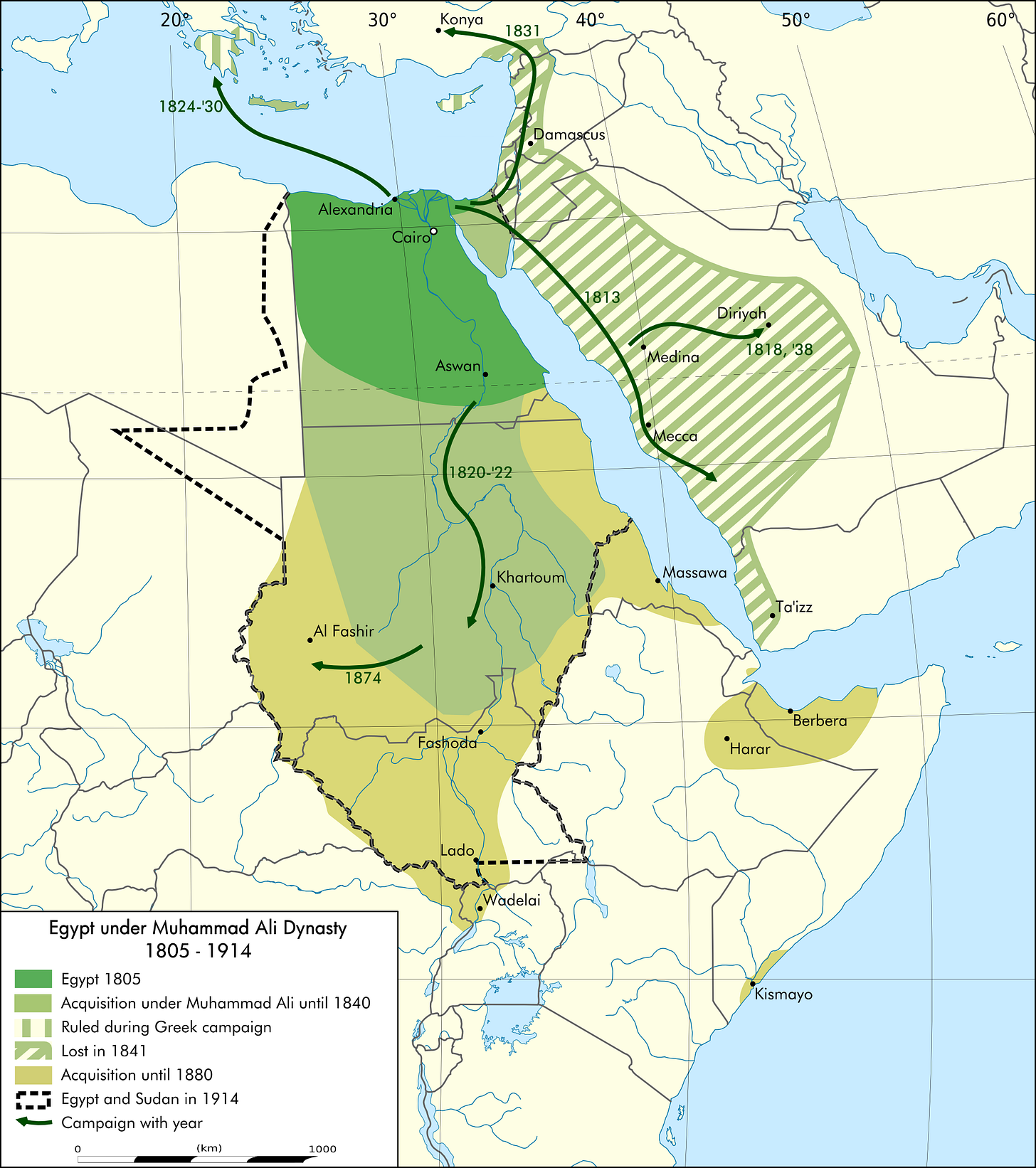

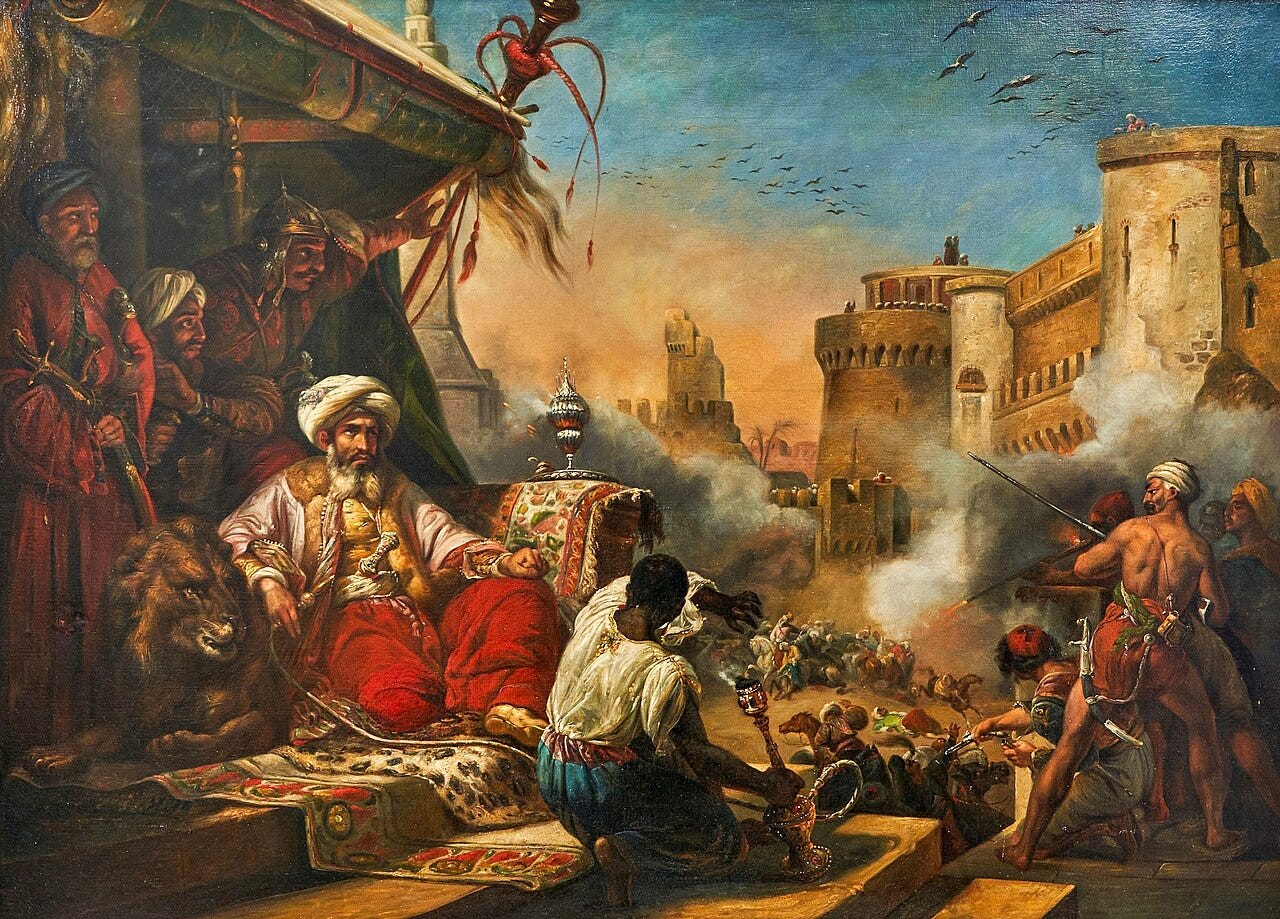
The man behind Egypt’s factories was no industrialist. He was a conqueror. Muhammad Ali Pasha was an Ottoman military officer born in modern day Albania who took power in Egypt in 1805. He spent his first decade consolidating control, through aggressive actions such as the Mamluk massacre of 1811 and reorganized Egypt's agriculture and taxation into a state-directed system. Then he turned his attention to empire building.
Ali sent armies south to conquer Sudan from 1820, seeking slaves for his new conscript army. Egyptian troops fought in the Greek War of Independence on behalf of the Ottoman sultan, winning Egypt ownership of Crete. Briefly, he even controlled part of Peloponnese before it was retaken by Greek forces. Ostensibly, Egypt was under Ottoman control but by the time of Ali the Sublime Porte was weak and ailing. And Egypt began to act with greater and greater impunity. Finally, he initiated the Egyptian-Ottoman War in 1831, sweeping through Syria into Anatolia with tens of thousands of troops, defeating the Ottoman army at Konya, and pushing as far as Kutahia in western Turkey before European diplomatic pressure forced a halt.
In a little over a decade, he grew the army from roughly 4,000 to 130,000. Muhammad Ali was nominally the sultan's governor. In practice he was a sovereign ruler building a regional empire that stretched from Sudan to Syria. At least in part, Ali’s industrialization designs existed to feed this military machine. Among other things, Egypt’s factories produced uniforms, footwear, fezzes, sails, guns, and artillery. But the industrial capacity he built was real. An iron foundry at Bulaq. A warship arsenal at Alexandria. Thousands of European technical advisors working across the country. Egyptian students sent to France to study engineering. By the 1830s, this was the grandest non-western industrialization the world had seen. Nothing on this scale would be attempted again until Meiji Japan, over a generation later.
The Energy Desert
…Egypt does not possess rivers or streams applicable to giving motion to manufactories; it is only necessary to add that water is the chief and most economical manufacturing power in all countries; it therefore appears absolutely necessary that she should be possessed of that power, to her becoming a manufacturing country.
The only remaining power applicable to machinery is that of steam. Can steam-power be used to advantage in manufacturing in Egypt? Here again Egypt is peculiarly situated; both nature and art appear to be inadequate to supply the means necessary to Egypt's becoming a manufacturing country; she is destitute of all kinds of fuel, coal, wood, or peat; the necessary ingredient in the cost and working of steam-power.
-John Bowring, 1840
No water power. No coal. No wood. No peat. Bowring is systematically ruling out almost every energy source available to any industrializing economy of the 19th century. So how on earth did Egyptian factories run? How were they powered? Well, Egypt in the 1830s did possess a modest amount of windpower, having erected roughly 200 windmills scattered throughout the Nile Delta for the purpose of crushing grain. But that’s not a lot and essentially the sum total of the country's non-biological power. Everything else ran on muscle, human and animal. Egypt’s economy was overwhelmingly dependent on biopower to a degree comparable to no European industrializer.
Some coal was imported from Britain, but the economics were devastating. A ton of coal that cost just 12.4 francs at Newcastle retailed at 75 to 100 francs in the interior of the Delta, a markup of six to eight times. And even at that staggering price, regular delivery could not be assured. This problem was possibly exacerbated by Ali’s strategy for labor recruitment: conscription. Factory workers were unwilling prisoners, forced by their government to work in brutal conditions for pitiful wages, significantly lower than even those in Belgium (which was able to industrialize despite notoriously low wages). In such a labor cost environment, steam power looks even less attractive. A steam engine consumed at least £6 of coal in a twelve-hour working day. For the same day, 400 Egyptian factory workers cost £4. At Egyptian factor prices, human muscle was literally cheaper than steam.
Competition for animal power made the energy problem even sharper. The perennial irrigation system alone required some 100,000 men and 150,000 oxen, working the sagiyas that lifted water from the river onto the fields. The factories and farms were drawing oxen from the same finite pool. Every ox working at a spinning mill was an ox not irrigating crops. Egypt's animal power was already near carrying capacity before its industrial ambitions. Muhammad Ali was acutely aware of this fuel deficit. "Coal! coal! coal! That is the one thing needful for me." He sent expeditions far and wide searching for seams. In the aftermath of the Egyptian-Ottoman wars, he briefly secured a small coal source in Mount Lebanon, enough to produce roughly 4,000 tons of low-grade lignite a year. This poor quality coal was highly sulfurous and unusable for iron smelting but burnable for food processing. Egypt would lose even this small source of energy just nine years after taking it.
Ali even attempted to cultivate his own fuel. Between 1828 and 1830 he planted some 1.1 million acacia and 300,000 willow trees across the Nile Delta, for the express purpose of building a source of charcoal. By 1831, more than 6,000 acres in Gharbiyya were dedicated to acacia forests. At the time, Egypt only had access to a handful of steam engines and acacia charcoal became a major source of fuel for these precious few engines.
A generation later, Khedive Ismail, a later Egyptian leader and Ali’s grandson, sent his own geological expeditions into Egypt’s eastern and southern deserts in search of coal seams. They, too, returned empty handed. Both rulers recognized the problem. Neither could solve it.
Inside the Factories
The first mills at Khurunfish and Bulaq were established in the late 1810s. These mills were equipped with modern industrial machinery from Europe but within the first few years they ran into issues. The machines broke down and the Egyptians themselves were at once, unable either to fix them themselves or find reliable European technicians. After this, Egypt eased up its reliance on imported European machinery. Instead, factories were provided with jennies and looms built by local Egyptian carpenters and smiths under the direction of French supervisors. Much of the iron for these machines came from the Bulaq foundry, the only such facility in Egypt. As Egypt had neither domestic iron ore nor coal, both had to be imported from abroad for Bulaq to operate.
“The fruit of the bull, O maidens!”
The cry of a Cairo street peddler advertising cotton
In the absence of available steam engines and fuel, the majority of motive power was provided by oxen. In the case of the spinning mills, eight oxen drove a wheel in four hour shifts throughout a twelve-hour day. This was not ideal. Not only were oxen expensive to sustain but they provided an inconsistent power output, slowing when tired and quickening when goaded. This led to frequent machinery breakdowns.
Conditions were grim for the animals and people alike. Egyptian factory workers were recruited by corvée, carted off from villages and tattooed so they could be identified if they tried to escape. Male factory workers were also frequently taken to fight in wars and in their absence, women and children would be “recruited” to fill their roles. Initially, wages were said to have been reasonable but by the early 1830s, they had fallen to near starvation levels. As with factory work elsewhere at the time, labor conditions were harsh and shifts were long. And fires, both accidental and intentional, are said to occasionally have ravaged mills.
Management was also far from optimal. Both Muslim and European overseers were described as corrupt and one English observer claimed that the French technicians intentionally withheld important technical information, remarking, “The Frank does all in his power to keep the Arabs in the darkness of knowledge.” As a result, as much as half of raw input material may have been wasted on average. Yet, in spite of these glaring inefficiencies and grim conditions, Egypt’s factories boasted real output. Thousands of tons of factory-spun yarn annually. Not only enough to easily meet Egyptian demand but enough to ship abroad to foreign markets. Turkey, Austria, Italy… Egyptian machine-manufactured cloth sold throughout the Mediterranean.
However, in spite of this burgeoning export market, by any honest accounting metric, Egypt’s cotton factories were not profitable. This however, is perhaps not surprising as it was frequently the case for early industrialization projects. Profitability notwithstanding, Egypt’s factories produced a lot of output and employed tens of thousands of laborers. For a country with almost no energy beyond the muscles of men and oxen, that in of itself was a feat.
Collapse(s)
Traditional accounts of the collapse of Egypt’s early industry attributed this decline to the interference of the British. This narrative however, overlooks the fact that Muhammad Ali’s industry experienced multiple collapses. The first came in 1833, when Muhammad Ali conscripted the factory workers to serve in the Egyptian-Ottoman war. The industrial workforce plummeted from ~30,000 to 6,000. At the war’s close, workers were sent back once more to the factories, but this disruption certainly did no favors for either factory output or machine health.
The second collapse unfolded in stages. Between 1837 and 1840, fifteen of the thirty cotton mills were abandoned. Europe fell into a depression and cotton prices fell. This greatly damaged demand for Egypt’s cotton. In response to these market shocks, Muhammad Ali attempted privatization, leasing factories to private entrepreneurs. By the late 1830s, it was clear that Egypt’s industrial project had seen better days. Then came the treaties. The 1838 Anglo-Ottoman Convention banned monopolies across the Ottoman Empire, fixed import duties at just 3%, and allowed British merchants to buy directly from Egyptian producers. Egypt however, effectively beyond Ottoman control, did not comply with this treaty until the Oriental Crisis a few years later. In addition to losing these economic levers, as a result of losing the crisis, Egypt was also forced to relinquish its territorial gains in Syria and Arabia and vastly reduce its military size. This diminished internal demand for goods produced in Egypt’s factories. By the early 1840s, Egypt no longer possessed any functioning steam engines.
The coup de grâce would be biological. Cattle plague. “Murrain” as British observers called it, spread like wildfire. Some historians characterize this plague as a natural disaster but historian Amr Khairy speculates it was an accidental result of Muhammad Ali’s land reform. Ali’s land reform in the 1830s spurred demand for more oxen and to meet this demand cattle were shipped from overseas. Some of these animals may have arrived infected. Either way, it was devastating. With no coal, little charcoal, broken steam engines, and now a declining oxen population, powering Egypt’s factories looked increasingly impossible. For a time Ali attempted to fill the gap by conscripting criminals to perform the backbreaking labor. The results were, unsurprisingly, poor. By 1845, Ali was waving the white flag, admitting that his industrial efforts were failing, and by 1849, just two cotton factories remained operational, producing uniforms for the army.
Historians still debate what killed the program. Some argue it was destroyed by British military intervention. Others argue it was already collapsing internally before the treaties. Roger Owen’s narrative suggests both: Internal decay preceded external pressure, but the Convention made recovery less likely, and the cattle plague delivered the killing blow. I suspect there is truth to this. Egypt’s industrialization efforts faced multiple headwinds and operated in a system that had no margin for error. Even with more favorable external circumstances, I’m not convinced Egypt’s industrial efforts would have been sustainable. It is frankly startling that Egypt made it as far as it did, in the absence of available non-biological power.
Sugar Survived
While Egypt’s cotton mills collapsed, its sugar industry survived. Muhammad Ali built three sugar factories by 1833 but cotton was the priority. For one, cotton was an import-substitute target. Egypt was spending large sums on European cotton and producing it domestically could stand to save them money. Moreover, both Britain and Belgium’s earlier industrial revolutions had begun with textile factories. Cotton looked like a natural starting point. Sugar was at best a sideshow. And yet, sugar continued to grow while cotton died. Five additional sugar factories were built between 1840 and 1845. Ali’s successors would continue this trend, expanding sugar production further. Part of the explanation for this may be that unlike cotton, sugar can be used to supply at least part of its own fuel. Sugar refineries worldwide burn bagasse, the crushed fiber left over after the cane juice is extracted. Every ton of cane crushed gives you fuel to process the next batch. In Ali’s own time, sugar factories were likely not efficient enough to leave behind much usable bagasse but as sugar factories became more sophisticated, Egypt’s sugar mills were increasingly able to supply their own fuel source. This, combined with an almost guaranteed domestic and export market may explain why Egypt’s sugar industry fared so much better than its cotton industry.
Egypt’s Second Industrial Experiment
In 1863, almost two decades after the end of Muhammad Ali’s reign, his grandson Khedive Ismail took power in Egypt. Ismail had an advantage his grandfather lacked: cheap steam engines. By his time, steam engines had become more affordable, more efficient, and much easier to acquire. The same year as Ismail took power, another cattle plague swept through Egypt. But this time, instead of dooming its industry, this disaster invigorated it. Egypt began importing steam engines in staggering numbers. Most of these engines were utilized for irrigation but some were installed in service of industry. By 1864, Egypt was importing roughly 20% of all steam engines exported by Britain worldwide. The results were dramatic. By the 1870s, there were over a thousand steam pumps operating in the Nile Delta alone, with a combined output of over ten thousand horsepower. This was orders of magnitude more steam power than Muhammad Ali had ever harnessed. But coal costs remained a thorn in Egypt’s side. The energy problem had not gone away. It was now manageable for narrow applications such as irrigation and cotton ginning but much of factory manufacturing remained unprofitable. Alongside this issue, the region lacked a reserve of skilled laborers who knew how to build and maintain industrial machinery. Egypt was able to further expand its sugar industry but this wasn’t enough.
Because, by this point, Egypt was rapidly losing autonomy. When the American Civil War sent cotton prices soaring, Ismail (and his predecessor) attempted to rapidly grow Egypt’s industry and infrastructure by using profits from the export of raw cotton. But then the war ended and Ismail was forced to take usurious loans from Europe to complete his modernization project. The results were disastrous. By 1875, Egypt was insolvent and had to sell its Suez Canal shares just to remain liquid. Four years later, Ismail was deposed under Anglo-French pressure, formalized by an Ottoman firman. If there ever had been a window for independent Egyptian industrialization, it was now definitively closed.
A Peculiar Situation
What happens when you try to industrialize on the power of muscle alone? As far as I know, Egypt is the cleanest case we have for this hypothetical. And the answer is, you can get further than you might expect. You can build factories, become a textile manufacturing power, even fabricate your own machinery. Egypt did all of these things. And for a few decades, it was the most industrialized economy in the non-Western world.
But at least in Egypt’s case, this industrialization proved unsustainable. Every component of the supply and production chain was fragile with minimal redundancies. Steam engines broke down and couldn’t be properly restored. Oxen died in plagues. Workers were effectively slaves. The sorry state Ali’s factories found themselves in by the 1840s, with criminals struggling to act as a power source, is a testament to the difficulty of industrializing without a reliable energy source. The economics simply were not there, at every step, Muhammad Ali had to push progress through legislative fiat. There were no market forces helping to relieve the burden. Egypt had no fuel of its own. Ambition alone cannot achieve industrialization. The factories you can build by decree. The energy to run them though, is not so easily commanded.
Books
Bowring, John. Report on Egypt and Candia (1840).
Owen, E.R.J. Cotton and the Egyptian Economy, 1820-1914: A Study in Trade and Development (1969).
Journal articles and chapters
Ahmeti, Samir, and Gazmend S. Rizaj. "European Impact on Egyptian Industrialization during the Rule of Muhammad Ali Pasha (1805-1848)." Journal of European Economic History 53, no. 2 (2024): 9-41.
Alleaume, Ghislaine. "An Industrial Revolution in Agriculture? Some Observations on the Evolution of Rural Egypt in the Nineteenth Century." In Agriculture in Egypt from Pharaonic to Modern Times, edited by Alan K. Bowman and Eugene Rogan (1999).
Batou, Jean. "Nineteenth-Century Attempted Escapes from the Periphery: The Cases of Egypt and Paraguay." Review (Fernand Braudel Center) 16, no. 3 (1993)
Bodenstein, Ralph. "Sugar and Iron: Khedive Ismail's Sugar Factories in Egypt." ABE Journal 5 (2014).
Fahmy, Khaled. "The Era of Muhammad 'Ali Pasha, 1805-1848." In The Cambridge History of Egypt, vol. 2, edited by M.W. Daly (1998).
Panza, Laura, and Jeffrey G. Williamson. "Did Muhammad Ali Foster Industrialization in Early Nineteenth-Century Egypt?" Economic History Review 68, no. 1 (2015): 79-100.
Online sources
Khairy, Amr. "Trees at the Dawn of the Anthropocene: Infrastructures of Empire." Les Carnets du CEDEJ (May 8, 2025). https://egrev.hypotheses.org/2940
Youtube
Egypt Ignited: A History of Steam Power in Nineteenth-Century Egypt. Lecture by Amr Khairy